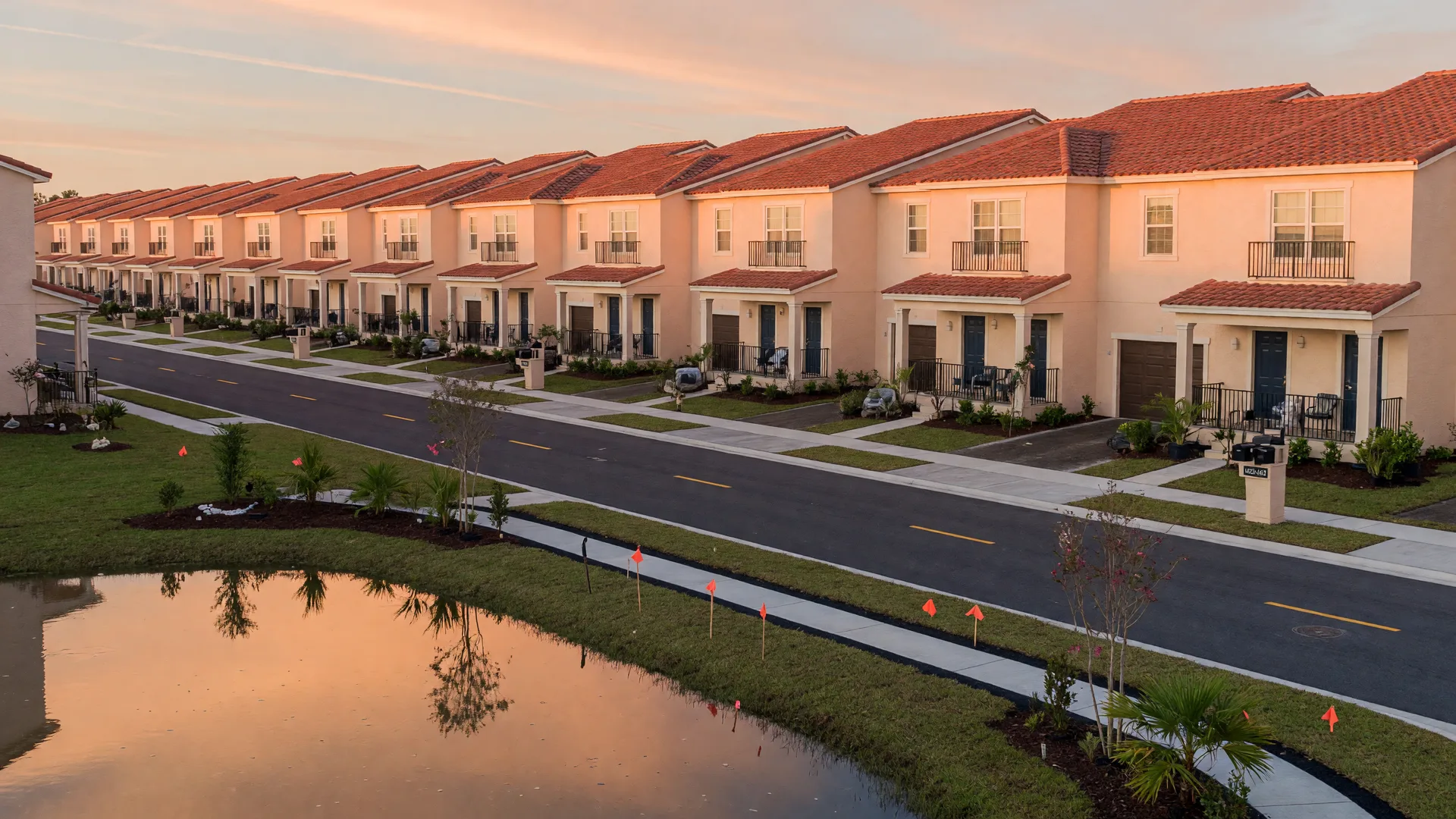
Investors look at new construction for reasons that are easy to state: new homes in growing Central Florida master plans tend to command the strongest rents in their submarket, and the first years usually carry little in the way of repair bills. But the comparison to buying existing rentals is not one-sided, and the fees, financing, and tax timing are different enough that the decision deserves a real underwriting process. This guide lays out the factors investors commonly evaluate, stated neutrally and without recommendations: rental demand, maintenance and depreciation, financing, and the HOA and CDD costs that come with many new Florida communities. It is educational context, not investment, tax, or legal advice: run your own numbers, and consult your lender, attorney, accountant, and tax professional before you decide.
Why investors look at new construction
The main draws are rental demand, condition, and tenant appeal. Central Florida's largest master plans, Sunbridge, Horizon West, EverBe, and the active Polk and Osceola County areas around Davenport, are still building, which means a continuing supply of places to rent in areas where employment and population are growing. A new home can rent from day one without deferred maintenance, and its builder warranty usually covers workmanship, systems, and structure for the first years. For investors who want predictable early years and a property that attracts quality tenants, the new build tells a clear story.
The trade-offs are equally clear. New communities stay under construction for years, with noise, delivery trucks, and amenities that may not be finished when you buy. Rents are typically at the top of the local range, which supports income but sits at the edge of what renters will pay. And the fees in new master plans, HOA dues, CDD assessments, and community maintenance, are recurring costs that do not exist the same way on an older resale. The honest way to compare is on the all-in monthly numbers, not the purchase price.
Cash flow: rent premium vs. recurring fees
A new home in a desirable community can often rent at the top of its submarket, because tenants pay for new condition, modern layouts, energy efficiency, and community amenities. But weigh that rent premium against the fees: HOA dues, a CDD assessment where one exists, property taxes on a new valuation, and insurance on newer construction. In some new communities, the recurring fees consume a meaningful share of the rent premium, so the net operating income can end up thinner than the headline rent suggests. The All-In Monthly Cost workbook in the New Construction Builder Secrets free guide was built for exactly this comparison, and it is worth running before you fall in love with a floor plan.
Maintenance and the first years
The clearest advantage of new construction for a landlord is the absence of deferred maintenance. For the first several years, capital expenses are usually low: new roof, new HVAC, new appliances, and a builder warranty covering workmanship, systems, and structure. That makes early cash flow more predictable than on an existing home with a repair backlog or aged systems.
The counterpoint is that this is a time-limited advantage. Warranties expire on their own schedules, and by the second decade a new build is simply a building with systems that age like any other. Investors comparing a new build to an existing rental should fund a maintenance reserve from day one rather than assuming the low early years are permanent, because the reserve is what makes the later years manageable. The difference between the two options is really a timing question: new construction concentrates costs in the purchase price and the monthly fees, while existing homes concentrate them in repairs and upgrades, and which pattern fits your plan is your call to make.
Depreciation and tax timing, stated neutrally
Residential rental real estate is depreciated over a multi-decade recovery period under IRS rules, and the land under the building is not depreciable. For a new build, the depreciable basis starts with the purchase price and the building share of that price, with the improvements new. Because the component costs of a new build are documented, some investors use cost segregation studies to reclassify components into shorter recovery classes and accelerate deductions. None of that is advice: the depreciation deduction, its timing, and how it interacts with your income and a later sale are questions for your tax professional.
Florida adds a state-level consideration for investors. Property taxes in Florida are based on assessed value, and a brand-new home is assessed as it is completed; the year after construction, the improvements are added to the tax roll, so the tax bill can rise in year two. The Save Our Homes assessment cap protects primary residences, and it does not apply to investment properties that are not the owner's homestead, and investors are not eligible for the homestead exemption. In practice, that means modeling the property tax into your cash flow at the post-improvement level rather than the first-year level, and confirming the current assessed value with the county property appraiser. This is a tax discussion, not tax advice: confirm the current rules with your accountant.
Financing a new build as a rental
Financing a new construction purchase can be more complex than financing an existing rental, for reasons tied to timing and to the property itself. On a to-be-built home, the loan often has two stages: a construction phase and a permanent loan after the certificate of occupancy, unless the home is already completed when you contract. On a completed new home, rental loans are often underwritten on the property's estimated market rent, because a brand-new build has no rental history, so the underwriting leans on appraisals and comparable rents. Investors using DSCR-style rental loans should expect lender requirements around credit scores, minimum loan amounts, and the certificate of occupancy at closing. Builders sometimes offer concessions that can offset closing costs on investor purchases, within program limits, and that incentive math is worth running with a lender before you sign.
Comparison matters as much for investors as for owner-occupants. Get a written quote for the investor loan from more than one lender, including the builder's affiliated lender, and compare rates, fees, lock terms, and the incentive. The rate lock guide on this site covers how lock terms interact with build timelines, which is the same machinery investors navigate, and the incentives guide covers converting builder offers into comparable dollars.
HOA and CDD costs in new communities
Most new Central Florida master plans have both a homeowners association and, in many larger communities, a CDD: a Community Development District created under Florida law to build and maintain roads, water, sewer, stormwater, and parks. The CDD assessment is a non-ad valorem special assessment collected on the annual property tax bill by the county tax collector, separate from regular property taxes and from the HOA dues paid to the private association. Assessments typically run for the life of the district's bonds, often twenty to thirty years, and the amount appears as a recurring line item on the tax bill.
For an investor, the CDD line is an unavoidable operating cost. It lowers the net income the property produces, it is usually not something the tenant pays separately, and it does not go away when the property is sold, because the assessment runs with the land. HOA dues and CDD assessments also shape resale, since a future buyer will underwrite them too. Before buying in a community with a CDD, verify the current annual assessment, what it covers, whether bonds are outstanding and for how long, and whether the assessment can be prepaid, and run the numbers through your cash flow. The site's CDD explainer walks through the details and the questions to ask.
Practical questions to run through before buying
- What is the all-in monthly cost: mortgage, taxes at the post-improvement level, insurance, HOA, CDD, and a maintenance reserve?
- What is a realistic rent for this exact floor plan and community, and what have similar homes actually rented for?
- What is the vacancy assumption for a new community still under construction, and how long will neighbors keep moving in?
- How does the purchase price compare to an existing rental in the same submarket, per purchase dollar and per month?
- What are the HOA and CDD amounts, what do they cover, and can either one rise?
- What financing is available, at what rate and down payment, and what does the builder incentive require?
- What is my exit strategy, and do the numbers support it if the community matures more slowly than expected?
- What does my tax professional say about depreciation, property taxes, and the eventual sale in my specific situation?
An investor-friendly resource, not advice
Tyler Gibson and the GPG Team work with buyers who are also investors, and Tyler's own experience includes long-term and short-term rentals plus light industrial commercial property, so the team reads new-construction contracts with an investor's questions in mind: cash flow, fees, exit strategy, and financing. That experience is context, not a promise of returns. The GPG Team can help you gather phase sheets, CDD numbers, and rental context across Central Florida communities so you can run your own comparisons, and it can refer you to lenders, attorneys, and tax professionals who serve investors. Start with the team's new-construction resources and bring your numbers.
Related reading on this site
Related reading on this site
- What is a CDD in Florida? Assessments on the tax bill
- New construction incentives: rates, upgrades, and closing costs, explained
- Rate locks and new build timelines
- Builder financing vs. a traditional mortgage
- Sunbridge: an Osceola County master plan with investor-scale inventory
- New Construction Builder Secrets: a free 31-page guide with the All-In Monthly Cost workbook
- New-construction resources from the GPG Team

Written by Tyler Gibson
Florida-licensed Realtor, team leader, and investor with 150+ transactions. Have a new-construction question this guide did not answer?